Two homes half a mile apart in San Rafael can list on the same Tuesday and follow entirely different pre-close checklists. Not because of price, condition, or buyer, but because a sanitation district boundary runs between them. On one side of that line, a sewer lateral inspection is a mandatory step before escrow closes. On the other, it isn't required at all.
This is the friction that catches even experienced sellers off guard, and it sits underneath every other pre-listing decision you make in this city.
The one address question that decides your calendar
Before you order photography, before you set an escrow timeline, confirm which sanitation district serves the parcel. The City of San Rafael is split between two agencies with opposite point-of-sale rules for private sewer laterals.
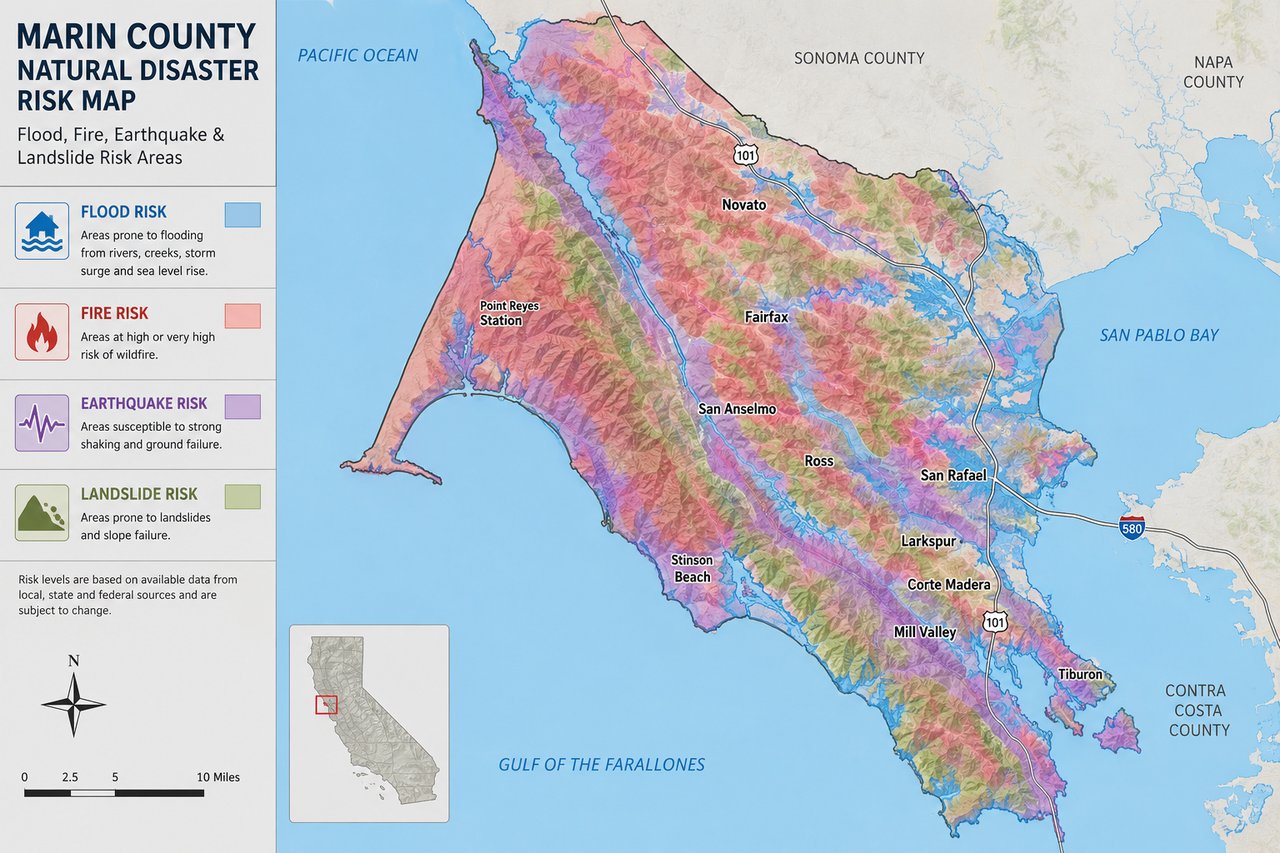
The San Rafael Sanitation District (SRSD) serves Central San Rafael south from the top of Puerto Suello Hill, along with unincorporated areas inside that jurisdiction. Las Gallinas Valley Sanitary District (LGVSD) handles the north side, including Terra Linda, Marinwood, and Lucas Valley. The City's own sewer lateral page is explicit that there are two districts inside city limits and that owners need to verify which one they fall under.
If you cannot answer that question by the time you interview a listing agent, everything downstream is guesswork.
What the RBR actually does, and where the 3x penalty hides
The City has been running a Residential Building Record inspection since the 1970s, codified under San Rafael Municipal Code Title 12, Chapter 12.335. Every residential sale in the city triggers one. It combines a records search of all permits, planning actions, and code enforcement history with a physical inspection of what is actually built on site.
The fee schedule is fixed: $383 for a single family home or condo, $766 for a duplex, $361 for the first apartment unit plus $44 for each additional. A staff inspector calls back within seven business days of the application. The report is valid for six months, extendable once by 90 days.
The friction lives one layer deeper. When the inspector identifies unpermitted work at the physical walk, the retroactive permit is not billed at the standard rate. The City charges three times the permit cost as a penalty. A water heater permit currently runs $168.75. When that same water heater gets called out during the RBR, the after-the-fact ticket lands closer to $675.
Pull the retroactive permits before applying for the RBR. The waiver only works one direction. Once the inspector has documented the violation, the 3x penalty attaches to that work item and follows the transaction.
There is one relief valve worth knowing. The City's published RBR policies waive fees and penalties for unpermitted work completed before the current owner's purchase, provided the item was not already noted on a prior RBR. The permit itself still has to be pulled and the work signed off, but the punitive multiplier drops away. For kitchen or bathroom remodels older than 25 years that added no habitable square footage, the City will acknowledge the work without requiring a new permit at all, so long as the inspector considers it properly constructed.
The LGVSD track: video first, review second
If your parcel is in LGVSD territory, the private sewer lateral inspection is not optional and it is not fast.
LGVSD requires a lateral and drainage inspection whenever a home is listed at $30,000 or more, or a building permit is pulled at $30,000 or more. The District requires inspections of all lateral and mainline related work before close of escrow. Reviews run on two tiers: standard at $250 with a 10 business day turnaround, expedited at $500 with a 5 business day turnaround. The inspection itself must be performed by a licensed plumber or a PACP certified inspector.
The published timelines assume the video already exists. It usually doesn't. The typical LGVSD sequence looks like this:
- Book a plumber with CCTV camera capability. Availability in Marin can run one to two weeks, longer near holidays.
- Camera the line and receive the video file.
- Submit the video, inspection report, and permit application to LGVSD with the review fee.
- Wait 10 business days for standard review or 5 for expedited. Expedited has been known to stretch a day past the promise.
- Receive the compliance determination, which categorizes the lateral as satisfactory, needing minimal maintenance, or requiring repair or replacement.
The only mandatory pre-close correction is illegal hookup removal, most commonly a roof downspout tied into the sewer. Repair or replace findings do not automatically block the sale, but they become a disclosed condition and a live negotiation item.
Start-to-finish, plan for the LGVSD track to consume three to five weeks in calendar time. If your escrow is 30 days, you are already behind on day one unless the video is in hand before listing.
The SRSD track: quieter, but not a free pass
If the parcel sits inside SRSD, the pre-sale posture is markedly different. SRSD's public FAQ confirms that the District currently does not require a sewer lateral inspection prior to sale.
That eases the timeline but does not eliminate the underlying exposure. A few points still matter:
- The property owner is responsible for the entire length of the private lateral, including the section running under the street. Nothing in the SRSD position changes that.
- SRSD's system covers 132 miles of pipeline and 32 pump stations feeding the Central Marin Sanitation Agency. Backups on an aging private lateral are still the owner's problem, and buyers know it.
- Buyer-side agents in this market routinely request a sewer inspection during the contingency period, even when the District does not require one. Sellers who volunteer a recent CCTV video eliminate a negotiation lever a buyer would otherwise use.
The absence of a District mandate is a scheduling advantage, not a disclosure shortcut.
A pre-listing sequence that respects both tracks
For a San Rafael seller who wants the RBR and any lateral work handled without stretching escrow, the order matters:
- Confirm the sanitation district by parcel address. SRSD if south of Puerto Suello Hill in Central San Rafael, LGVSD if north side. Verify against the City's service area map rather than relying on a mailing address.
- Pull a personal permit history. Every past permit sits in the City's records. Compare it against what is actually installed at the home.
- File retroactive permits for anything unpermitted. Water heaters, furnaces, air conditioners, and gas fireplace inserts are the routine catches. Do this before the RBR application.
- If LGVSD, book the CCTV video. This is the long-lead item.
- Apply for the RBR. Six-month validity means you can file it before listing photography without risk of it expiring in escrow.
- Submit LGVSD paperwork as soon as the video is back. Choose expedited if the listing is already live.
- Assemble disclosures with the RBR, the LGVSD compliance determination or the SRSD position, and any retroactive permits already signed off.
Two 2026 changes worth marking on the calendar
The City moved its permitting and licensing to OpenGov this year. As of February 17, 2026, all inspections must be scheduled through the new system. As of February 23, 2026, all new permit applications must be submitted through it, and paper applications are no longer accepted. Any seller playbook printed before this spring has stale process instructions. Budget an extra day or two the first time you file through the new portal.
The RBR has also become the enforcement moment for vegetation management plan approval when a property transfers to a new owner. If your parcel has any Zone 0 exposure, expect that question to surface at the RBR walk rather than as a separate track.
FAQ
Does an off-market or family sale skip the RBR? No. The RBR program applies to sale or exchange of any residential building in San Rafael. There are narrow exceptions such as the first sale of a new home and mobile home sales.
Can I close escrow with a failed LGVSD lateral if the buyer accepts it? LGVSD requires inspection before close of escrow. A finding that recommends repair or replacement is a disclosure item, and buyers commonly negotiate a credit or holdback rather than force the work before closing. Illegal hookups are the exception and must be corrected.
What if my RBR flags something I do not want to permit before closing? The report becomes part of the buyer's disclosure package. Any required actions, permits, fees, or penalties transfer to the buyer if the sale closes without resolution. This is legal, and it is also the fastest way to erode your negotiating position on price.
How long is an RBR good for? Six months from inspection date, with one 90-day extension available on request. Expired reports require a new application and a fresh inspection.
Selling in San Rafael rewards sequencing more than any other move in the transaction. If you want a candid read on how your specific parcel sits between the two districts, and a pre-listing calendar that respects both, Staal Real Estate is set up to walk you through it. Schedule a consultation before you apply for the RBR, not after.